The Agile Industrial Complex: Selling Fear, Shipping Diagrams
January 19, 2026.
The goal in consulting is to be the perpetual expert at the Next Big Thing™ your clients want. But you don't want to be too far ahead of them, as you'll be attempting to sell them something they don't know they want yet. Ideally, you want to be cresting the wave of vacuous LinkedInfluencer posts and Business Insider articles, about six months after the first VC Medium post, and six months before your board asks why you're "behind".
Once you've identified the topic du jour, your job is to build a market. There are lots of ways to do this, but a common and effective one is fear. Your goal is to create a hard-to-pin-down, but palpable, existential dread. A dread that unless your clients are "using AI"/"in the cloud"/"doing devops"/"being agile" that they have abdicated their responsibility to their shareholders, who are mere moments away from storming their corner office and dragging them to the Place de la Révolution.
This pipeline is particularly obvious with (upper case A) Agile consultants, disciples of a movement that began with a short manifesto and good intentions but where a feeding frenzy has developed in the last decade. Their Next Big Thing™ has been "helping" organisations become more (lower case a) agile in the way they work. The market they've made is a confusing litany of terminology, processes and certifications that are sold as the solution to you being outcompeted by smaller, nimbler competitors.
The Great Game
Never one to miss an opportunity to trademark a dubiously valuable proprietary process, Agile consultants have created frameworks by the dozen, each differentiated by more arcane, labyrinthine diagrams than the next with their concentric circles, infinity loops, colour-coded swim lanes, and arrows that appear to point backwards in time; but each designed to passive-aggressively prod their competitors into whimpering submission.
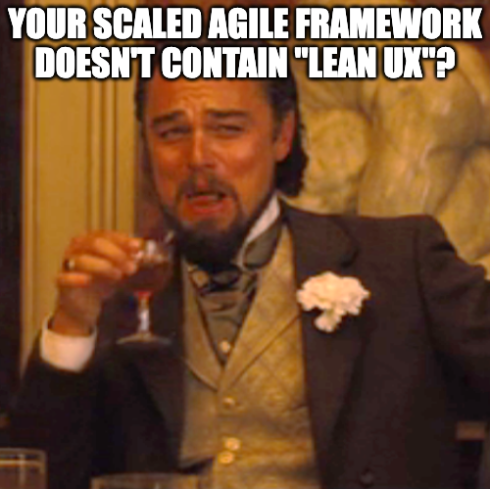
The central conceit of these frameworks is that there is some abstract, Socratic ideal of how a product and technology organisation should be run. That all businesses are just a Kanban board or Zero-based Design Session away from Nirvana.
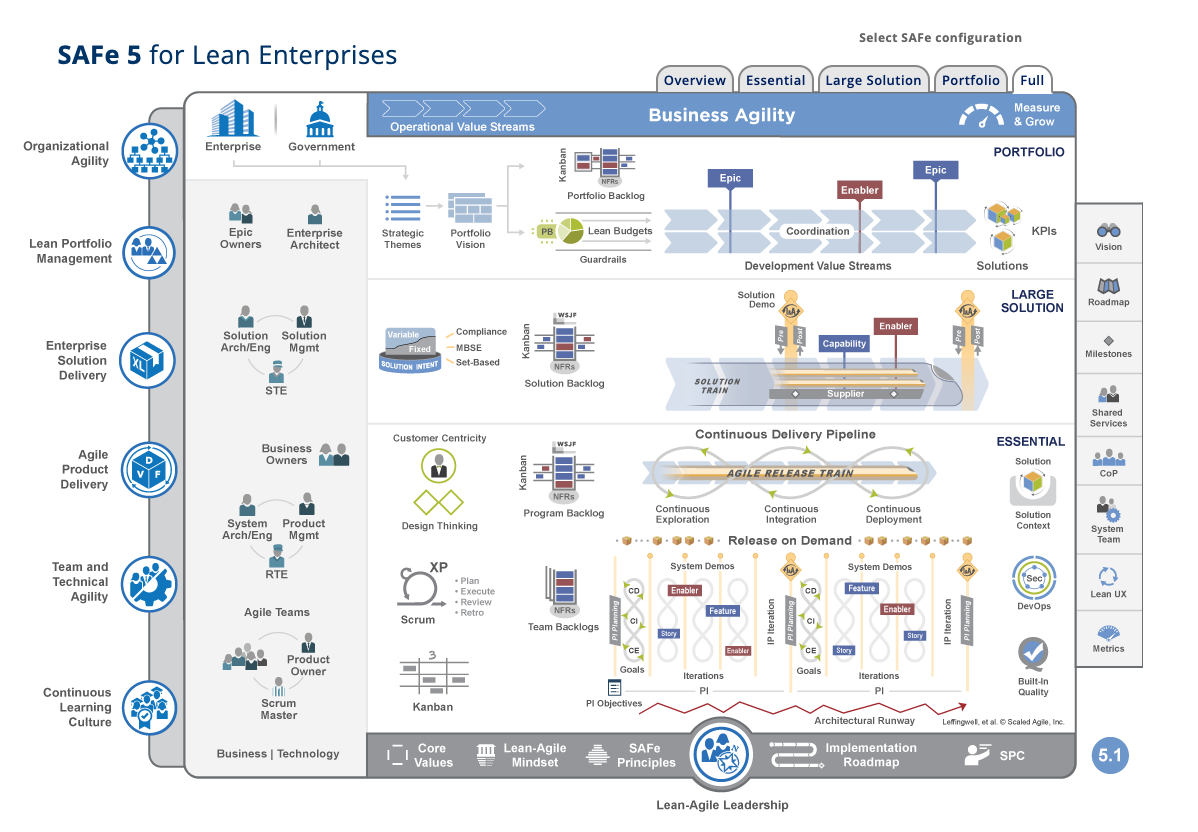
Criticising "agile frameworks" is like shooting fish in a barrel, so I just present this diagram, a typical example, with no further comment:
Like any religion, Big Agile needs to paint the path of enlightenment to its followers. This is how Spotify works, is it not? Don't you want to be like them?
Do as I say, not as they do
There's an "agile" ghost story that consultants particularly enjoy telling, and it goes by the name Spotify.
The story usually opens in hushed, reverent tones. Once upon a time, somewhere in the mists of early-stage hypergrowth, Spotify discovered a delivery and organisational system of near-perfect efficiency. It involved tribes (ew), squads, and guilds. There were complex-looking matrix diagrams. There were tasteful shades of green. There was, allegedly, harmony. It was the promised land, a Nirvana, the very apex of organisational efficiency. Similar tales are told about Netflix, Google, Monzo and a hundred others.
You’ve probably seen the slides. Complicated-looking PowerPoints adorned with the Spotify logo, pointing confidently towards a promised land of autonomy, velocity, and innovation. This is how the best companies work, you are told. Don’t you want to be like them?
Consultants tell these ghost stories for a reason. They create a sense of dislocation: look how different you are from this shining ideal. These slides allow the Agile consultant to glean some shared credibility or brand equity through their "insider" knowledge. If we were being equitable, consultants would owe Spotify $millions for the amount of use they've made of their brand to shill dubious transformation programs.
Like all good ghost stories, there may once have been a mundane, prosaic truth at the centre of it. Something practical. Something contextual. But it has been retold, embellished, and corrupted to suit the needs of the teller. Passed on in whispered tones until it bears only a passing resemblance to reality. It’s as if someone half-overheard Henrik Kniberg in a noisy bar in Stockholm, didn’t quite speak enough Swedish to fully understand what was being said, and nevertheless decided to preach the gospel.
The uncomfortable truth is that these organisations do not work in the way you’ve been told they do. Not now, and often not then.
I say this as someone who has sat on the consulting side of the table and worked inside a few of these supposedly idyllic palaces of productivity.
The people working at Spotify, Netflix, Google, Monzo, or whichever company currently occupies the consultant’s pantheon, do not experience their days as a frictionless nirvana of empowered teams and perfect flow. They complain about inefficiency, organisational debt, technical debt, too many meetings, unclear priorities, and incentives that don’t quite line up — just like your teams do.
They feel the same existential pressure. They argue about the same trade-offs. They make the same compromises. They ship the same regrettable decisions and spend the same amount of time unpicking them later.
Often, the only material difference is that they have the political will—or structural permission—to respond faster. Not because they discovered a sacred diagram, but because they are willing to tolerate mess, ambiguity, and occasional failure in service of movement. That quality does not fit neatly into a framework, which is why it is rarely sold.
Our players
So who perpetrates this vaudevillian satire? Who, forsooth, are our players?
The Agile Coach
Among the most visible of these new roles is the "Agile Coach", a human whose supposed job it is to go into an organisation and "coach" them to be more "agile". In practice, this mostly means hiring someone who's au fait with a single framework to tell you things like the way your "business stakeholders" describe their "pain statements" don't correspond to the dogmas of Enterprise Agile®.
I've worked with ~hundreds of Agile Coaches in my career, and I can count on one hand those that weren't charlatans. The overwhelming majority of Agile Coaches are people who've memorised the way "things should be done" without an iota of real experience of doing "it" themselves, having seen "it" done particularly well or even knowing what "it" really is. Agile Coaches have memorised the review of the movie adaptation and are being hired to teach a class on the book.
The handful of "agile coaches" I've worked with whom I would work with again are people who would abhor being painted with the title and reject the anointed scriptures. They are experienced generalists. They're people who can turn their hand to strategy, product, UX, technology, or any of a dozen disciplines with enough capability and experience to slowly nudge an organisation in the right direction. To be a dogged, determined instrument of an organisation's will. They also, to a person, have significant experience of having done "it" before and can, with the right support, maybe help you do "it" better.
The Agile Practitioner
This is a group of people for whom I have endless sympathy, trucked off at the behest of upper management to a bland conference room at a suburban hotel for three days of indoctrination as a Certified Scrum Master™ by glassy-eyed people who smile too much. I imagine it's what it's like if your boss joins Scientology.
The goal is for the people to learn new skills that can help them with their jobs, which is admirable, but I've seen too many a bright young thing leave their team excited and enthusiastic for a few days of agile training and return haggard, cynical, and with only a cheaply printed certificate that imminently goes into a drawer. Sadly, they haven't acquired a decade of experience in a few days, as their boss was probably sold. Their hopes of a job transformed, leading from the front with a new set of capabilities, are left withered in a suburban Travelodge car park.
The Self-Licking Ice Cream Cone
Agile itself is not the problem. Like most things that end up capitalised, trademarked, and laminated, it started life as a fairly reasonable response to a real set of constraints. The problem is what happens when a set of ideas becomes an industry.
Once that happens, the incentives shift. The goal is no longer to help organisations work better, but to perpetuate the machinery that sells help. Certifications must multiply. Frameworks must differentiate. Diagrams must become more complex, not because reality demands it, but because simplicity is very difficult to invoice for.
What emerges is not a movement, but a self-licking ice cream cone.
Agile is simply one of the more successful strains of a much broader consulting pathology: the endless manufacture of urgency around the Next Big Thing™. Today it might be agility. Tomorrow it will be something else. The names change, the diagrams get redrawn, and the conference lanyards are reissued, but the underlying game remains the same.
If there is a lesson worth taking from the companies so often held up as exemplars, it is not that they follow a particular model. It’s that they are willing to make trade-offs, accept imperfection, and act with urgency and intent. None of that is especially exotic. Unfortunately, none of it is particularly marketable either.
Related posts
- Fee models in consulting
Large strategy consulting organisations charge in several ways and they're evolving so that the consultants take on more risk
Published on August 25, 2023 in Consulting
- Delivering a bad product faster isn't going to save your business
An 'agile transformation' is one of the surest signals that an organisation's leadership has fundamentally misunderstood the challenge it faces
Published on January 4, 2022 in Consulting
- My rate card
I'm a strong proponent of everyone charging more for their time, and is something I've seen be particularly stark in consulting. Why I share it openly and you should too
Published on December 30, 2021 in Consulting